
The tower’s Cannon weights several tons and it stands for a good example of defence artillery from the end of the eighteenth century. It was transported from a different location and carefully reconstructed. Today it represents an ornament to the southern part of the Upper Town and the tower’s attraction of its kind.
Damad Ali Pasha`s Turbeh is located across the Upper Town’s plateau. It has an octangular base and is one of the few well preserved monuments of Islamic culture in Belgrade. Turbe (domed burial site) got its name after the great vizier of sultan Ahmed III, Damad Ali Pasha. The mausoleum was built in 1784 over …
Continue reading “Дамад Али-пашино турбе Damad Ali-pašino turbe Damad Ali Pasha`s Turbeh”
This Building was built at the end of the nineteenth century for the needs of Serbian army. During the First World War it suffered substantial damages. Thus, from 1923 to 1927 it was reconstructed and added onto in a baroque style. From 1934, a part of exibition of the Military Museum dedicated to the assassination …
Upper Town’s Small Gate is located between “Victor” monument and the building which houses the Institute for the Protection of Cultural Monuments, Belgrade, surrounded by a former medieval rampart. Constantine Philosopher refers to it as “the Small Gate in the west”. It served as a communication between despot Stefan Lazarevic’s castle and Savska slope. The …
Continue reading “Мала капија Горњег града Mala kapija Gornjeg grada Upper Town’s Small Gate”
The well was built during the baroque Austrian reconstruction of the Fortress, in the period between 1717 until 1731, when it was named “The Big Well”. The name “Roman Well”, first mentioned in the nineteenth century, came as a result of folk tradition according to which most of the structures of forgotten origin were linked …
Continue reading “Велики или Римски бунар Veliki ili Rimski bunar Big or Roman Well”
The gate was built within the south-western rampart, in the period between 1693 and 1696. It got its final shape during the Austrian reconstruction of the Fortress in the first decades of the eighteenth century. The gate has a baroque appearance, with a half-vault and rooms located at the inner side of the rampart. At …
It is located in front of the King Gate. Its construction began in 1689, during the first Austrian occupation of Belgrade. At the time of Austrian siege and bombardment of the Fortress, on August 1717, Ravelin suffered considerable damages, but it was rebuilt from the grounds the very next year.
The scale model of despot Stefan Lazarevic’s castle is located accross the Upper Town’s plateau. It is the work of Kolja Milunovic which represents despot’s castle with towers, gates and drawbridge above a trench, and distinctive dojon tower called Nebojsa.
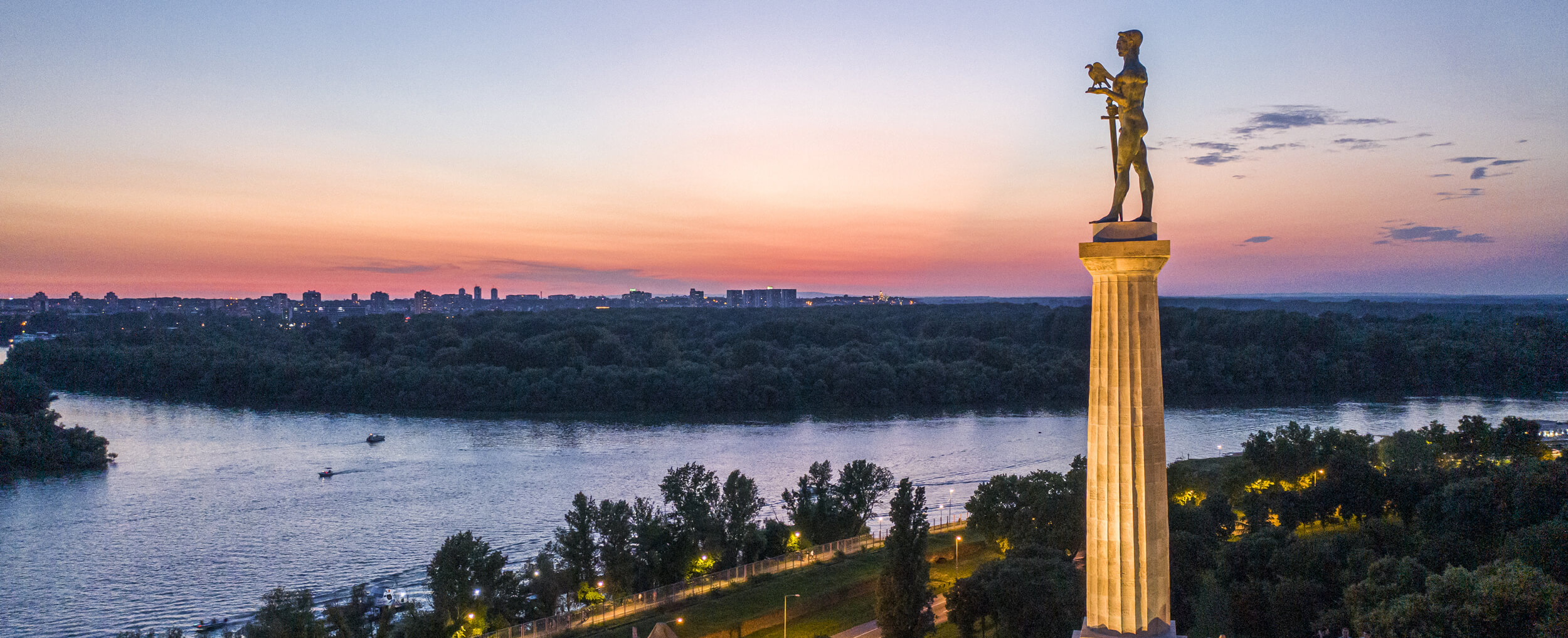
The monument is the work of sculptor Ivan Mestrovic. Its pedestal is made of stone, while the sculpture representing a man with an pigeon is made of bronze (14 metres high). “Victor” was unveiled on the Upper Town’s plateau during October 7–8th, 1928 to commemorate the decennial of breaking through the Solun front.
t was unveiled in 1986. It has inscriptions on both Serbian and Hungarian language. It was dedicated to the successful defence of the Castle of the Belgrade Fortress against the Turkish attack in the night between July 21st and 22nd, 1456. Even sultan Mehmed II was injured during this attack, so he ordered his army …