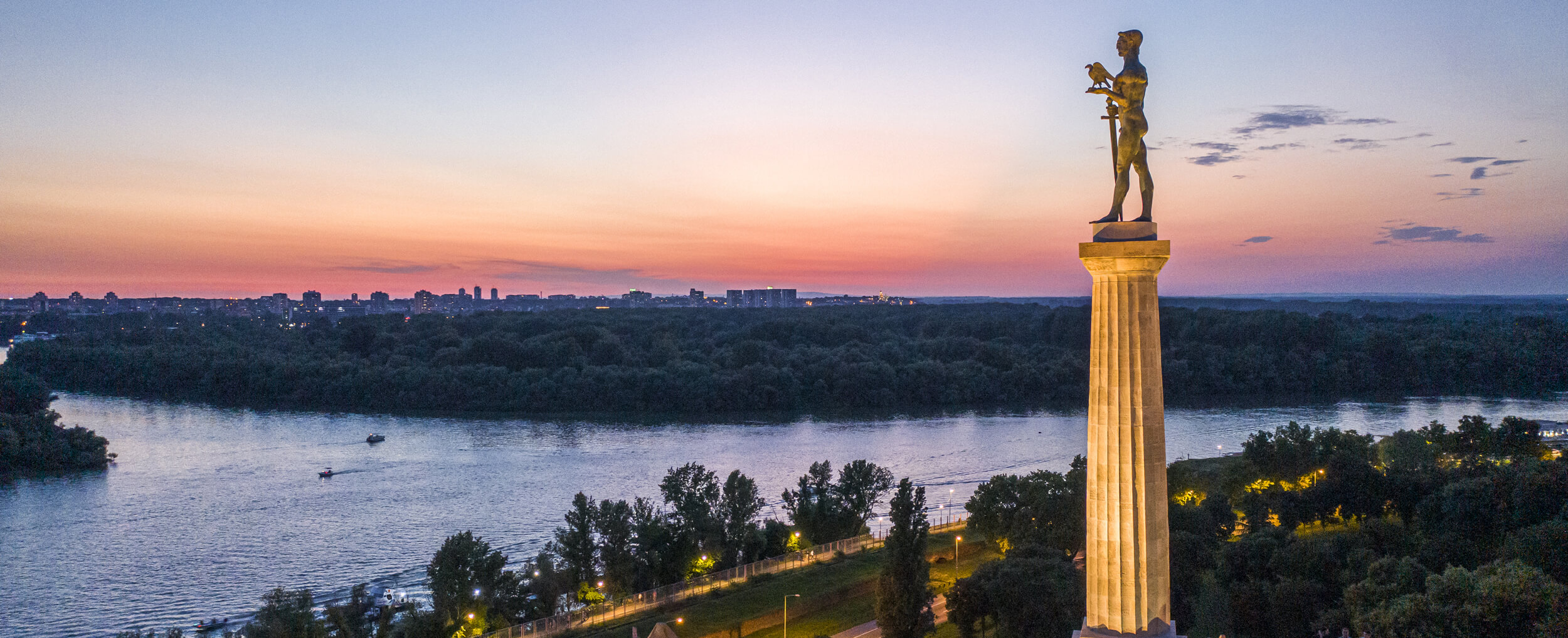
The spacious plateau between the mouth of the Rivers Sava and Danube and white lime ridge, after which Belgrade got its name, represents the Lower Town’s plateau. During the rule of despot Stefan Lazarevic, this area was fortified and urbanised. It stood for an economic, cultural and spiritual centre of the despotate. Currently, the Lower …
The church was dedicated to the holiday of the Birth of the Mother of God. The building was at first used as one of the three powder magazines constructed during the period of Austrian reconstruction of the Fortress. In 1867, after the Serbs restored the Fortress into their power, the powder building, with an added …
The construction of the building started in 1935 in place of an old chapel, above a spring which is considered to have miraculous powers. It was completed and revived on the day of St. Petka-Paraskeva, October 27th, 1937. Architect Miomir Korunovic was in charge of the project. While digging the grounds for the Church of …
Continue reading “Црква Свете Петке Crkva Svete Petke St. Petka`s Church”
It is located in the wall beneath Jaksic’s Tower. The mausoleum was built in 1937 after the reconstruction of the tower and erection of St. Petka’s Church. It preserves the bones of Serbian defenders who died while defending Belgrade during the period between 1914 and 1915.
The octangular defensive tower was built in the period between the eleventh and fifteenth century. The Austrians demolished the Jaksic’s Tower during the period of reconstruction of the Tower between 1717 and 1739, since they considered it to be unnecessary. In 1937, the tower got its final form after the reconstruction of the rampart and …
Continue reading “Јакшићева кула Jakšićeva kula Jaksic`s Tower”
It is located in the Lower Town and it originates from the eighteenth century. There was a powder magazine at the place of today’s Hamam, which was destroyed in an explosion in 1690, together with surrounding buildings and a part of the old wall, creating a cutting in the hill. In this cutting the Turks …
Continue reading “Амам – старо турско купатилоAmam – staro tursko kupatilo Hamam – Old Turkish Bath”
It was built during the great Austrian reconstruction of the Belgrade Fortress between 1718 and 1720. The goal was to make a safe powder shelter, a place protected from the enemy artillery. It was often called Odier’s powder magazine. This powder magazine is designed in such manner that a long hallway connects the two chambers. …
Continue reading “Велики барутни магацин Veliki barutni magacin Big Gunpowder Magazine”
The gate originates from the eighteenth century. The first gate was built by the Austrians as a part of defensive system of the northeastern front facing the Danube River, but it was destroyed. At that same place the Turks built today’s Vidin Gate. It got its name after the direction of the road leading to …
It is integrated in the northeastern rampart of the Lower Town. It was built in 1736 in the honour of the tsar Carlo VI, “the great conquer of Belgrade”. Gate is an exceptional baroque achievement in areas south of the Sava and Danube, and by all accounts, is the work of Balthasar Neumann, famous German …
Continue reading “Капија Карла VI Kapija Karla VI The Gate of Carlo VI”
It is located between the gate of Carlo IV and Nebojsa Tower. It leans against the remains of northeastern rampart of the Lower Town. It was built in the second half of the eighteenth century and it is made of stones and bricks. Upon the siege of the Tower, Karadjordjevic’s insurgents used this building as …
Continue reading “Војна кухиња Vojna kuhinja Military Kitchen”